Free Union Wood and Garden Journal

Name:
Location: Free Union, Virginia, United States

Saturday, May 17, 2008

Herbs in, Birds gone, and Ladyslippers in bloom


Nearly a year after the last update, there's a lot to tell, but it's a beautiful spring day so why not take the laptop outside...

About one month ago while Dev was in Arizona for a week, I put an herb garden in, reclaiming an old wood pile just off the West end (if the front door faces East) of the deck. Almost everything has thrived due to a wet spring (finally!) and a judicious increase in sunshine allowed by the trees we took out about two years ago. I say "about" because we used the firewood from those trees this past winter, so it must have seasoned about that long. More on that after the generic update:

We took a walk through the woods yesterday and saw several Laydyslippers in bloom, and looking quite healthy. Nice to catch them before it's too late! This is graduation weekend at UVA, and if memory serves, this is about the same time we thought to go looking for them last year (ed: same weekend almost to the day!). Hopefully I'll grab a good camera and get some pictures while they're at this stage, but the flowers are large and lush, and there are several other plants with healthy leaves, so we'll see if we get more blooms down the road.

The herb garden has been a pleasant suprise - the first real planting done here since we took out a few trees, and I noticed today the deck and garden areas recieve about two hours of direct sunlight this time of year. With the generous rains we've had I've not been shy about watering with the soaker hose too, and I'm sure that's helped. We're starting to think about putting in a rain barrel which would make it easier on the conscious for feeding the plants, but we'l see what happens with that ;-)

In no particular order, the herb garden has:


Kentucky Colonel Mint (x2, background above): Robust, Sweet, and with a very strong (but pleasing) mint aroma. Compared to the mint I seeded last year (?), it is less milky and more minty - it'l be great in Deven's tea!

Rosemary Arp (x2, foreground): has thrived but grows slowly, with a great aroma off the leaf. Strong and green, I have no idea what we'll use this in, but look forward to it!

Chives Garlic (x2): two small bunches center things, small bunches but aromatic. I just trimmed some of this grassy delight for our salad tonight, there's not a great deal of it so I'll be interested to see if it's enough to add a little zing.


Silver Edged Thyme (x3) - these small clusters have thrived as well, not growing quickly but consistently, and add a really nice visual element. Te aroma is beautiful and I'm looking forward to a tomato sauce, etc, that we might use this in.

Rosemary Salem (1, no pic): this came from a different greenhouse than the rest an looked very robust before planting, but does not seem to be growing as fast. It's on the houseward side of the garden, and I'll be interested to see what becomes of this singular planting.


Lavender Provence (x4) rounds out the outside of the curve on the garden and has thrived as well. Planted while nearly flowering, we've had pretty much at least one extra flower shoot per plant. I believe these are perrenial and self-seeding, so I hope to see more next year!

On the interior of the garden, I added a flower and herb (thinking the herb was just a flower) to add some color:


Dame's Rocket (Hesperis - Purple) - is a biennial that was flowering when planted and maintained for over a month, until heavy storms knocked off most (but not all) of the blooms. As advertised, attracted butterflies immediately and thrives thus far. I wouldn't hesitate to add more of this next year.

Agastache "Blue Fortune" (Anise Hyssop) Blooms May to November but has not done so yet. Chose this as a late bloomer for the fall and simply to add color to the garden, but the Anise aroma is strong - yet wonderful - and will be great in tea.

Other than that - the chick brood over the window (returned to the almost the exact same place as last year, but on the other side of the windowsill) took flight today. I don't know if they are gone from the nest for good, I should probably go inside in case my presence is what keeps them away...
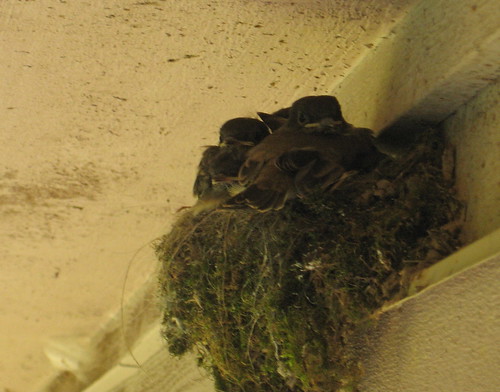
chicks

This photo was taken about one hour before I began writing this post. Looks like they've flown the coop - for good!

Labels: , , , , ,

Sunday, July 22, 2007

The Bear is Back


... at about 10PM last night he dined in our garbage - a very big boy and looked quite healthy!

Via the VA dept. of Game and Inland Fisheries:
(http://www.dgif.state.va.us/hunting/va_game_wildlife/living_in_bear_country.html)

Of the 3 bear
species (black, brown, and polar bears) in North America, only
the black bear lives in Virginia. Shy and secretive, the
sighting of a bear is a rare treat for most Virginians. However,
bears are found throughout much of the Commonwealth, and
encounters between bears and people are increasing. Most
encounters are people who have the opportunity to view a bear in
the wild, but given the right circumstances, bears may cause a
variety of problems/nuisances. However, a basic understanding of
bear biology and implementing a few preventative measures will
go a long way to helping make all your encounters with bears
positive.


Black
Bear Facts


  • In
    Virginia, most black bears live in the mountains and the
    Dismal Swamp, but they are frequently found in all counties
    except a few in the east.

  • Black
    bears are typically crepuscular (active at dusk and dawn),
    but can be active any time of day.

  • Bears
    may feed up to 20 hours per day, accumulating fat (energy)
    prior to winter denning. An adult male can gain over 100
    pounds in a few weeks when acorn production is heavy.

  • Female
    black bears have smaller home ranges (1 to 51 square miles)
    than males (10 to 293 square miles).

  • Black
    bears are generally solitary, except sows caring for cubs.
    Adult bears may be seen together during the summer breeding
    period.

  • Bears
    are omnivorous and opportunistic feeders, eating mostly
    plants in the spring, berries and insects in the summer, and
    nuts and berries in the fall. Bears have been observed
    capturing live animals, both wild and domestic. Carrion
    (dead animals) is often a part of a bear’s diet. Predation
    of livestock is not common, but is reported each year.

  • Adult
    female black bears weigh between 90 to 175 pounds. Males
    commonly weigh between 130 to 400 pounds. The largest known
    wild black bear was from North Carolina and weighed 880
    pounds.


  • Depending on weather and food conditions, black bears enter
    their winter dens between October and January. Bears will
    not eat, drink, urinate or defecate while denning. Bears are
    easily aroused and may be active during warm winter days.
    They emerge from their dens from mid-March to early May.

  • In
    Virginia, most bears den in large, hollow trees. Other den
    types include fallen trees, rock cavities, brush piles in
    timber cut areas, open ground nests, and man-made structures
    (culvert pipe).


  • Harvesting timber promotes the growth of many plant species
    that yield heavy berry, insect and other food sources.

  • Female
    black bears mature as early as three years old. Breeding
    occurs from mid-June to mid-August, and cubs are born from
    early January to mid-February.

  • Female
    black bears usually breed every other year as cubs are
    raised by their mother for about 1 ½ years. When the mother
    is ready to breed again, she will send her cubs to fend for
    themselves during the summer months when food is usually
    abundant. Always hungry, these yearling bears, particularly
    the males, will seek easy sources of food like pet food,
    birdseed or trash/garbage.


  • First-year cub mortality rates are about 20%, primarily due
    to predation (foxes, coyotes, dogs, bobcats, other bears) or
    abandonment by their mother sow. Adult bears do not have
    natural predators except humans.

  • Bear
    habitat must include food, water, cover, denning sites and
    diverse habitat types. Although bears are thought to be a
    mature forest species, they often use a variety of habitat
    types, including old fields and clear cuts or other timber
    harvest areas.

  • Bears
    may live up to 30 years in the wild. The oldest wild bear in
    Virginia lived 26 years.

Labels: , ,

Wednesday, April 11, 2007

Birds are back


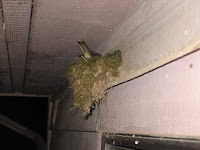
This nest seems to have been under construction for about two weeks; walking outside just a few nights ago I startled this guy, and when he flew away I thought itmust have been a bat (early evening, twilight). The nest went up in fits and starts over the last month, but the big build seemed to take just a day (someone must be motivated) and the moss blanket on the exterior of the nest in just a day.

This nest is on the top of the window frame on the south porch, the westernost window facing south from the living room. Good luck little guy!

Labels: , ,